Council, Explained: Council Can’t Fix What It Doesn’t Control But Council Always Has the Ability to Act
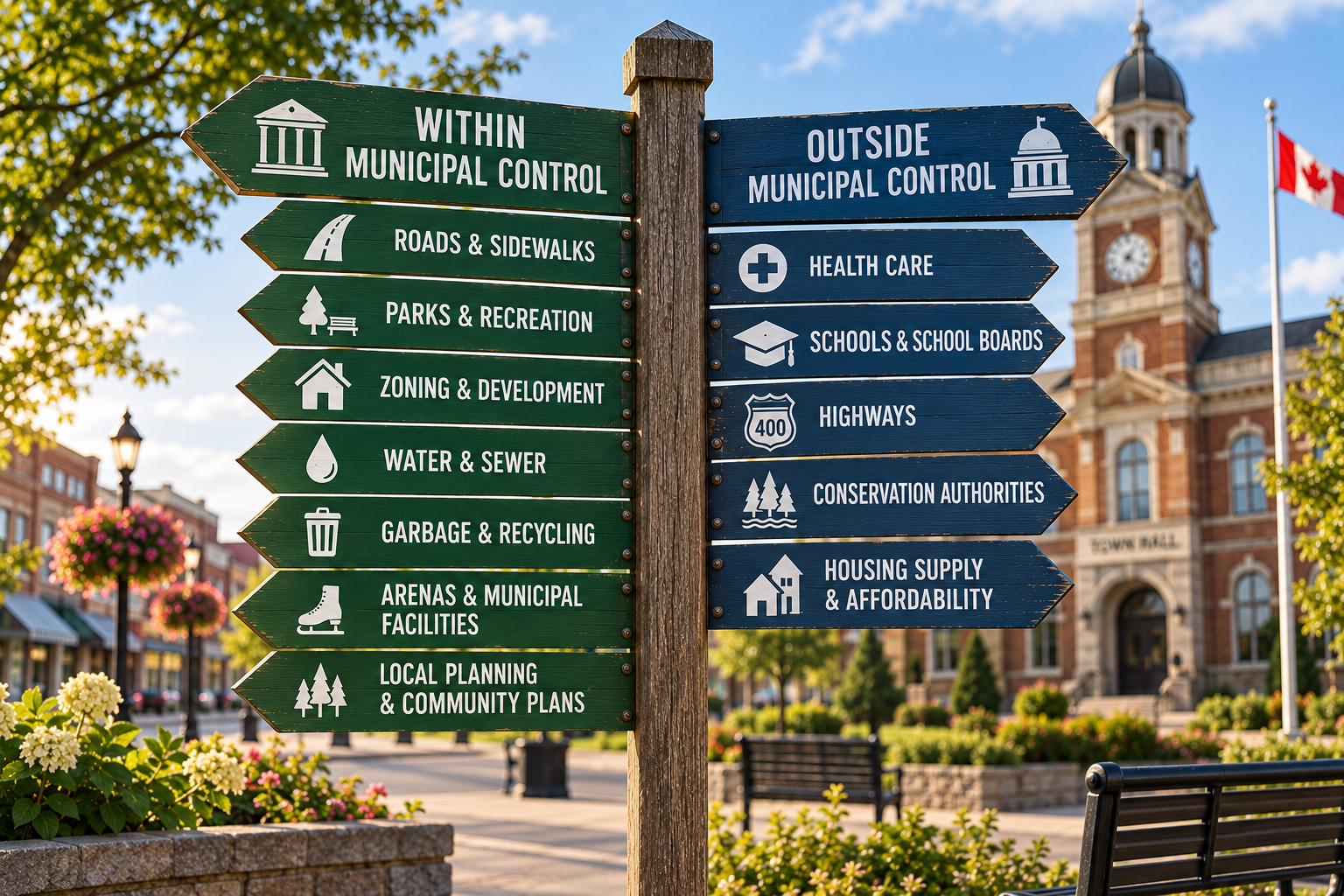
Image by AI
Editor: Laurel Davies Snyder
Municipal elections feel personal, and they should. What you experience in your community is personal. The cracked sidewalk is on your street. The pothole is on your drive to work. The arena is where your kids play. The housing shortage affects your family and colleagues. The lack of doctors affects your parents and your neighbours. The empty storefronts are in your downtown beside your favourite coffee shop. The speeding cars are in your subdivision. The school closure, the highway project, the ambulance delay, the increasing rent, the line at the hospital, the police response times, and the development proposal down the road — all of this and more is happening in your community and directly affects you and the people in your life.
When we are frustrated with things in our community, we expect someone local to be responsible and accountable. Naturally, we go to the level of government closest to us – our local municipality - and ask, “Why doesn’t Council just do something?” and “Who is going to look into this and fix it?” These are reasonable questions, especially when the issues are on our streets, in our neighbourhoods, in our parks, and affecting our daily lives. We should expect leadership from the people we elect to represent us. But before marching down to City Hall, emailing a Councillor, or posting a rant on social media about the difficulty finding a local doctor, the pothole, or the school closure, it’s important to understand that not every issue affecting you in your community is in the control of your local municipal government.
A challenging part of local government is figuring out who is responsible for what in your community. Even though something seems to be entirely local and it seems like the Municipality should be responsible, it may actually be the responsibility of another level of government, another organization, or a private business, and completely outside of the control of the local municipality. This becomes more complicated when candidates for Council say “I’ll fix that” with great authority and turn public frustration into promises. This sounds like leadership and like someone finally gets it. It also sounds like a promise to act. But before accepting this promise as fact, ask whether Council has the authority and ability to control the issue. Can they keep their promise to the community?
Everyone Needs a Doctor: A shortage of family doctors is felt locally. It affects families, an employer’s ability to recruit workers, the capacity of emergency rooms, the overall well-being of a community, and so much more.
But a municipality, including Municipal Councillors, does not control the health care system – health care is the responsibility of the Province. A municipality cannot simply create doctors, choose to fund local hospitals using the Province’s resources, or redesign Primary Care because residents require more services and are frustrated. Councils can however, advocate, provide support, help with recruitment efforts, offer space for new medical practitioners, work with partners to develop a strategy, and make the community more attractive to professionals and families in the medial field. Council does have an ability to act, but this is different from controlling the entire health care system.
Everyone Needs Somewhere to Live: Housing challenges are being felt across North America. Locally, we are seeing more applications to build new subdivisions and apartments, increasing Development Charges, and challenges with providing services for new housing (like water and sanitary services). The costs to rent an apartment and pay our taxes keep increasing, we’re seeing increased numbers of unhoused people in our communities, and we’re hearing more debates about growth.
Municipalities do have very real responsibilities with respect to housing and residential development including:
setting land use planning policies (where housing is located, allowing Additional Residential Units (ARUs), affordable housing policies, etc.);
managing Zoning By-laws (the specific regulations for housing like height, number of residential units per property; distance of a dwelling from property lines, etc.);
coordinating and providing infrastructure and servicing (municipal water, municipal sanitary services, etc.) and;
managing the planning and development application processes (applications for infill housing in the downtown or for a new subdivision, applications for an Additional Residential Unit (ARU) in someone’s backyard, etc.).
There are also many factors affecting housing that Councils cannot control, including factors that influence the supply, location, type, and cost of housing. Council does not control interest rates, the availability or cost of materials and specialized labour needed to build housing, landlord-tenant legislation, Provincial housing targets, Federal immigration levels, or private-sector decisions about what to build where, when to build, and how much a final product sells for. When a candidate talks about “fixing housing,” voters should listen carefully for whether they understand which part of the housing system Council can actually manage and influence.
Everyone Needs to Safely Get Around Their Community. People need to get safely and efficiently to work, school, the library, the community centre, a friend’s home, the doctor, and many other places essential and important to their lives. Providing and maintaining the infrastructure that allows us to safely walk, wheel, and drive in our community is critical.
Although a municipality can control infrastructure for cycling, wheeling, and walking, controlling roads for buses, cars and trucks is a different story. A road may run through your community without actually belonging to your local municipality. Some roads are municipal, some are county or regional, and some are provincial highways. The fact that people drive on a road every day does not automatically mean that the local municipality owns it, maintains it, controls the speed limit, approves every access, can install pedestrian crossings, or can decide how and when it gets rebuilt. This does not mean Council is powerless to advocate for improvements or coordinate with other municipalities or levels of government, but it does mean that a promise to “fix the road” should come with an understanding of who has authority.
There are many parts of our local community that are not governed or controlled by our local Council. Schools, policing, social services, conservation authorities, provincial planning rules, utility systems, private property decisions are key parts of our communities that are not within the control of the local municipality. We don’t always see the complete system, and do not always have time to figure out where our frustration with a community problem should be directed – is it a municipal, provincial, federal, private sector, school board, non-profit organization issue?
So, when we’re experiencing an issue or problem, what should we do?
Understanding who really has the ability to act, and what is within Council’s control is part of why elections are complicated. Voters want someone to answer for what is happening in their community and candidates may feel that they are under pressure to be the person with the answer. But local government works through authority, legislation, budgets, policy, evidence, public process, and partnerships. Sometimes the person - or Council - being held responsible for addressing a problem may not be the person with the authority or power to solve it.
A serious candidate for Council should be able to explain Council’s ability to act, influence, and advocate. In other words, explain Council’s role and responsibilities, and the difference between what Council can control and what it can’t. This may sound like saying “it’s not my job” but these distinctions matter and can change the conversation and our understanding of who participates in our community.
Council’s Direct Responsibilities
There are things a local Municipal Council is solely responsible for and can control. Council can approve the Municipal Budget, set local service levels, pass By-laws, make decisions about land use planning, direct municipal priorities, invest in municipal roads, parks, facilities, technology, staffing, asset management, recreation, and local infrastructure, and decide how transparent, prepared, disciplined, and respectful its own decision-making will be. These are the real powers of Council, and voters should absolutely expect candidates to understand this, and use these powers effectively.
Council can also use municipal resources to support conditions that make certain outcomes more likely. Council can remove what may seem like unnecessary local barriers, support grant applications, strategically assemble and use municipal land, bring people to the table, and align and coordinate infrastructure, planning, and policy in ways that move the community in a better direction.
Council’s Ability to Influence
There are things Council can leverage and influence to benefit the community and achieve community goals. Council can work with property owners, developers, agencies, community organizations, neighbouring municipalities, Indigenous communities, school boards, health partners, businesses, non-profit organizations, and other levels of government to build relationships and networks and develop support for common goals and shared projects. Influence is different than being able to fully control something, but influence can still make an enormous difference between being seen as a proactive and engaged community or as a closed community and resistant to change.
Council’s Ability to Advocate
There are also situations where Council’s most appropriate – and legitimate - role is to be an advocate. Council can pass resolutions, write letters, meet with Provincial Ministers, support community campaigns, participate in regional conversations, raise concerns in a public forum, and use its platform to push for change. Advocacy can be important when a local issue is of great concern to a community but is outside of Council’s role or responsibility and needs the attention of the people or organizations who have the control, resources, and authority.
A candidate who understands these differences would not promise full control for items if Council’s actual role is to influence or be an advocate. These candidates would not pretend that advocacy is the same as having full authority and control over a project. They would not turn every community frustration into a campaign commitment that in the end, Council can’t actually keep. These answers may be less flashy, but these answers are truthful and more useful.
Understanding Jurisdictional Theatre
Every election has a degree of jurisdictional theatre, and voters should learn to recognize it. The politics of saying “I’ll fix it” are tempting and Council candidates tend to make dramatic promises about issues that they may not actually have the authority to resolve. If people are angry about something, there is pressure to be the candidate who says, “I will deal with this.” No one wants to be the person standing at the door explaining intergovernmental responsibility while someone else is offering a cleaner, louder, more politically-satisfying answer – even if it’s wrong. No one wants to say, “Well, that’s complicated,” when the candidate down the street is saying, “This is a simple fix. Elect me and I will take care of it.”
Voters should be cautious when someone states that every issue is easy to fix, solve, and totally within the municipality’s control. Be cautious when a candidate says they will “stop” something without explaining whether Council has the authority to stop it. Be cautious when someone promises to “build” something without explaining who owns the land, who funds the project, who operates it, and whether the municipality can afford the ongoing costs. Be cautious when someone promises to “fix” a provincial or federal problem using only municipal tools. Be cautious when a candidate thinks that saying “I care more” creates legal authority to act. Caring matters. It just does not magically expand municipal authority.
This does not mean Council candidates and Council as a whole should be passive. It is completely legitimate to reject the answer “that is not our responsibility” even if the problem is technically outside of Council’s control. This answer may be accurate, but it feels dismissive. Shifting responsibility away from local Council is not a solution for the community. What people are asking for is someone to listen and help them figure out how to address their concerns; people are rarely asking for a lecture on roles and responsibilities in municipal government.
Good candidates should care deeply about issues affecting their community, even when issues are outside municipal control. Council still has the ability to act and, in situations when they don’t have control, is required to think strategically and creatively about how it can act within its jurisdiction. Council should be prepared and willing to be a financial partner, collaborator, advocate, and coordinator to move items forward in a strategic manner. Council should be willing to examine available and appropriate municipal tool and not throw up their hands the moment something becomes complicated and hide behind the term “jurisdiction”. Communities need strategic thinking, creativity, and leadership.
A Council may not control the health care system, but it can support a physician recruitment and retention strategy by collaborating with regional partners, providing space, advocating to the province, and using land use planning tools to build communities that improve everyone’s health and quality of life. A Council may not control the housing market, but it can make sure the municipal zoning categories, servicing plans, approval processes, community improvement tools, and growth policies are supporting housing opportunities for everyone, and not making the situation worse. A Council may not control systems and strategies for homelessness, addiction, or mental health, but it can work with service providers, police, public health, non-profits, upper levels of government, and neighbouring municipalities to figure out how to respond in a strategic, coordinated, humane, and effective way. A Council may not own a provincial highway, but it can document safety concerns, request improvements, keep pressure on the province, and make sure local planning decisions include the impact of the highway on community members.
The fact that Municipal Councils have a defined role and responsibilities in terms what they can control, influence and advocate for in their community should not be an excuse for not addressing community concerns. But it should change the promises that candidates make during a campaign. A serious candidate does not say, “I alone will fix this.” A serious candidate says, “Here is the part Council can control, here is the part we can influence, here is where we need to advocate, here is who else needs to be at the table, and here is what I would actually do.” That answer may not fit neatly on a lawn sign, but it is a much better indication that the candidate understands the job.
A candidate who says, “Council does not fully control that, but here is what we can do,” may understand the file better than the candidate who simply says, “I will handle it.” A candidate who says, “That would require provincial funding,” may be more serious than the candidate who says, “We just need leadership.” A candidate who says, “I would need to understand the staff report, the legal risks, and the policy framework before deciding,” may be more prepared than the candidate who gives an immediate yes or no based on the loudest voices in the room. The candidate who understands and communicates Council’s actual abilities to act is giving voters the correct answer.
Voters deserve candidates who will not overpromise just because community frustration is politically useful. Community members deserve elected officials who don’t hide behind jurisdiction when leadership is possible. The right approach is about telling people what Council can do and telling people what Council cannot do. The right approach is also about explaining how Council can influence and advocate and what that would look like. Sharing who also has authority and how Council can partner with them, what a partnership might cost, how long it would take, what the risks are, and the limitations are all important things to talk about.
This fall, candidates will talk about the issues affecting many of us right now. Issues like housing, affordability, infrastructure, access to local health care, public safety, economic development, growth, roads, services, recreation, and quality of life are important.
As voters, we should listen for whether candidates understand Council’s ability to act. Can they control an issue, influence it, or be the advocate for change? Does the candidate know who else needs to be involved? Can they explain the municipal tools they would use if they were attacking the issue? Are they promising an outcome, or are they explaining a role? Are they giving you a plan or just giving your frustration the microphone? Not every problem on your doorstep belongs entirely to City Hall, and not every promise made at your doorstep can be delivered from the Council table.
That does not mean Council does not matter. It matters enormously. Local government shapes the services, infrastructure, planning decisions, public spaces, budgets, and priorities that affect daily life. But it operates within a larger system, and the best candidates understand how to explain this, and work within that system and what they actually can control.
So, when someone tells you they are going to fix the problem, ask one more question.
“How?” Not because you are cynical but because you are hiring someone for a job with real powers, real limits, and real consequences. The people most ready to serve don’t promise they can control everything. The people ready to serve understand what Council can actually do, what it cannot do alone, and how to lead.
Building and caring for the communities we want to live in requires effort, resources, commitment, creativity, and coordination. Sometimes dealing with an issue is within the control of our local government and sometimes it involves the provincial government, a specific organization, or it’s the responsibility of a personal business. But sometimes, dealing with an issue and making the situation better for everyone is within our control, like picking up litter in our neighbourhood park, helping a neighbour shovel their driveway, becoming a regular customer at a local business, volunteering to be a crossing guard, or serving meals at the outreach centre. It’s important to remember that we all have the ability to act, influence, and advocate for what matters in our community.