ELECTION MINI SERIES: Thinking About Running For Council? Start Here.

Every municipal election cycle, we hear people passionately talking about local issues in their community and saying the same thing:
“Someone should do something about this!”
There’s a sense of hope and even a sense of excitement. The idea that maybe this time, something will be different and things can change.
Every four years, we can vote for the people we believe in to represent us on our Municipal Council. To make decisions about who to vote for, we listen to different ideas and perspectives. We’re often drawn to the candidates who speak most directly to our own concerns. A promise to lower taxes. A commitment to fix a road in your neighbourhood. A strong stance on a single issue that matters to us.
But the reality is, many of us are making the decision to vote for someone without fully understanding what the role actually involves, and more importantly, what a Member of Council can do and realistically deliver.
And when our expectations don’t line up with reality, frustration with our elected officials builds. Decisions feel slow. Priorities don’t always make sense. Things don’t change as quickly as we’d hoped. And that’s usually when the questions start.
Why is this taking so long?
Why can’t they just fix this?
What’s actually going on at that table?
Once you start asking those questions, your perspective begins to shift.
It’s no longer just frustration—it becomes curiosity. And you start to ask different questions.
Could this be done differently? What would it actually take to be part of those decisions?
And for some, that’s when the question eventually becomes:
Maybe that someone could be me.
---
Closing this gap between the perception and reality of the role of Municipal Councils is about. Helping people better understand how this system actually works and how everyone can play a part.
Running for Council is one of the most important ways to shape your community - but it’s also one of the most misunderstood. Because the reality is, there’s often a disconnect between what people expect from Council, what the role requires, and Council’s ability to act. In fact, many sitting Council Members are navigating these complexities every day, often with more constraints than people realize.
In the weeks leading up to the election, the articles in this series will break down 4 things:
How local government actually works
What to look for in candidates running for Municipal Council
What the role of a Municipal Councilor really requires
How to make more informed decisions at the ballot box.
And once you start to understand more about these four things, it will become clear that the role of a Municipal Councilor is probably unlike anything you’ve ever been part of before.
Yes. There are meaningful moments – you get to be part of shaping your community and supporting important initiatives. However, a lot of the work happens behind the scenes, and it’s not always straightforward.
So what does the role of a Municipal Councilor actually look like in practice?
It’s Not What Most People Think
Many people step forward because they care deeply about a specific issue and that’s important. But once you’re at the Council table, you aren’t able to only focus on one issue. You’re required to consider and make decisions about everything presented to Council - often with less information than you’d like, competing priorities, and limited resources.
In reality, most of your time won’t be spent on that one issue that motivated you to run.
It will be spent navigating everything else.
Another common misunderstanding is that Council Members are involved in day-to-day operations - that’s the role of Staff Members. Instead, the role of Council is to set direction, review recommendations, and make decisions based on policy, professional advice and long-term impacts.
Take something like road improvements. It might feel like a simple fix, but municipalities are required to have Asset Management Plans that set priorities for infrastructure improvements across the entire entire community using consistent criteria. Every Councilor is advocating for their area, but decisions are made within that broader system.
The same goes for taxes. A large portion of municipal budgets is committed to essential services and long-term infrastructure needs, leaving less flexibility to allocate funds to specific initiatives.
The role of Council is less about quick wins, and more about judgment, trade-offs, and long-term thinking.
Understanding the Responsibility
Sitting at the Council table isn’t just about having a say. It’s about making decisions where there’s rarely a clear “right” answer.
You might be looking at a housing proposal that some people strongly support, and others strongly oppose. A road project that one neighbourhood sees as urgent, while another is wondering why theirs isn’t first. A budget where every dollar spent in one place means a dollar not spent somewhere else.
And all of it comes to you at once.
Behind every decision is a stack of reports, policies, and financial realities. You’re working within legislation like the Municipal Act, long-term budgets, and provincial rules that don’t always leave as much flexibility as people expect.
Sometimes, even when a decision feels right locally, it still has to stand up to external review—through bodies like the Ontario Land Tribunal.
And while all of that is happening, you’re also navigating public pressure, differing opinions at the Council table, and the responsibility to treat people—and the process—with fairness and integrity.
That’s the part most people don’t see.
It’s not always about making the most popular decision in the room. It’s about making the one that holds up when you step back and look at the full picture.
Because once the vote is done, you don’t just move on—you live with the outcome. So does your community.
Why Educating Yourself Matters
If you’ve ever had that thought—“Could I do this?”—this is where you start.
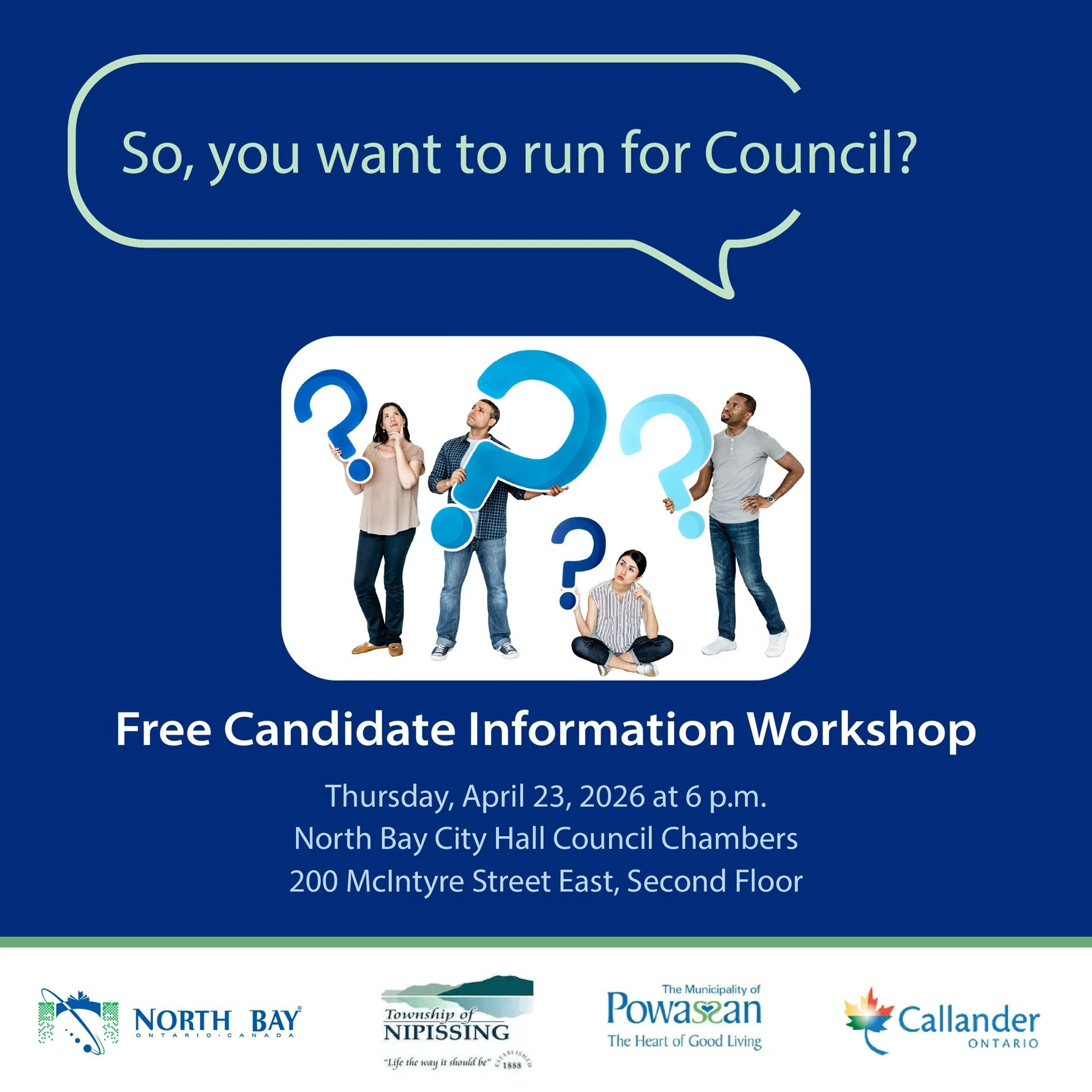
Although this session is being held in North Bay, there are several other municipalities hosting similar information sessions throughout Ontario.
Not with a campaign. Not with a sign. Just with a better understanding of what the role actually looks like.
The “So You Want to Run for Council” session on April 23 isn’t about politics. It’s about pulling back the curtain.
It walks through what really happens at the Council table, how decisions get made, and what’s expected of the people sitting there. The time commitment. The reading. The pressure. The responsibility.
Because the goal isn’t to convince you to run—or to scare you away from it. It’s to make sure that if you do decide to put your name forward, you’re doing it with a clear understanding of what you’re stepping into.
If you’re thinking about putting your name forward, taking the time to understand the role is part of the job—not an extra step. And as voters, it’s fair to expect that the people asking for your vote have taken that step.
If you can’t make the local session, the Association of Municipalities of Ontario also offers workshops that provide a broader look at how municipal government works and what it means to be an elected official.
For Future Candidates—and Voters
The session isn’t just for people thinking about running. It’s also for anyone who plans to vote.
The kind of Council we get is shaped by what we look for in the people running.
If we focus only on promises alone, we’ll get promises.
If we focus only on who speaks the loudest, we’ll get noise.
But if we start to understand what the role actually requires—judgment, patience, the ability to weigh competing interests—we start to look for different things in the people running.
We start asking better questions.
We start paying attention to how candidates think, not just what they say.
And over time, that raises the bar—for everyone.
For the people putting their names forward, and for the decisions being made at the table.
Because good governance doesn’t start on Election Day. It starts with a community that understands the role well enough to choose the right people to fill it.
Interested in Learning More?
The So You Want to Run for Council session on April 23 offers a clear, practical overview before you make that decision.
If you can’t attend, the Association of Municipalities of Ontario also offers workshops that provide a broader look at municipal government and elected roles.
Whether you’re considering running, or simply want to better understand how decisions get made, the April 23 session is a great place to start.
Because the Council table shapes your community every day.
Understanding it—even just a little better—can make a bigger difference than you might think.