Sometimes voting "No" can be the Right Answer
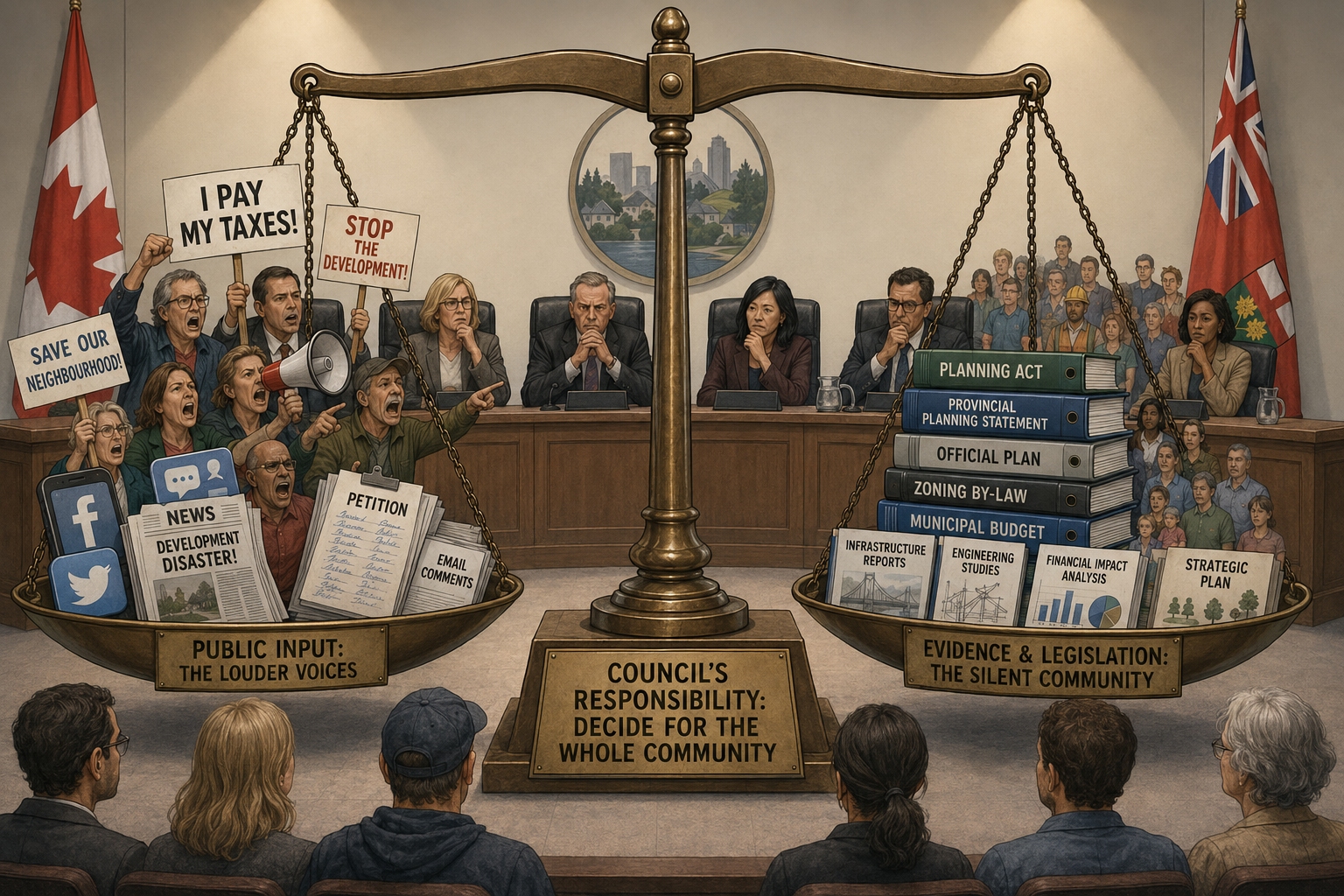
Image created with AI.
Editor: Laurel Davies Snyder
Why the best Councillors understand that sometimes, voting “no” can be the right answer for the community, even though it means that the decision will upset and disappoint a room full of people.
Local government is one of the few places left where you can watch and participate in democracy in real time. During a Council meeting, you may witness extreme body language, eyerolls, whispering, and the occasional dramatic exit through the back door of the Council Chamber.
If you've ever sat through one of these meetings, you know the rhythm. Things often start out politely. A staff report with a recommendation is presented to Council. A few residents step up to the microphone to share their thoughts and opinions. Council listens and asks questions. Things seem to be progressing well – people are sharing information, listening, asking good questions, nodding, even smiling. But somewhere around the hour mark, the temperature in the room shifts and then, after Council votes, half the gallery is vindicated - and claps and cheers- half is furious, and somebody in the parking lot is muttering "unbelievable."
What happened?
Here's the part nobody really explains. Sometimes the people who are furious about how Council voted are right. And sometimes they're not. The same decision and resulting vote can be seen as a Council failing its community, or as a Council doing exactly what it was elected to do – represent the interests of the entire community. From the outside, these two scenarios seem identical.
Understanding the intent behind a vote and what goes into decision-making is one of the most useful skills a voter can build, especially in an election year.
The people who show up and participate in Council meetings don’t represent the entire community
Here are a few things worth keeping in mind about Council meetings.
A full Council Chamber feels like the whole community has shown up. But it hasn't. Even a packed room is usually less than one percent of the population a Council was elected to serve. In a city of 55,000, the 200 people in front of the microphone, however loud, however passionate, however organized, are not the entire constituency. They're a small slice of it – about 0.36% - and are usually focused on preventing something that they see as negatively affecting them right now. Overall, the people who show up are typically the people who are opposed to the application or issue. Even though everyone is welcome at Council meetings and all comments are taken into consideration by Council, it’s rare for those in the community who support an item or application to show up to express and share their support.
A Councillor isn't elected to represent and make decisions for only the people who are in the room during the Council meeting. Councillors are elected to representeveryone, not just who shows up. Their decisions must take everyone into account. Their constituency includes parents who couldn't find a babysitter. Shift workers who were on the job. Seniors who don't drive at night. People who don’t have a car and rely on public transit. Renters who never get Public Meeting Notices. People who are intimidated by the Public Meeting format and afraid to speak in public. Thousands of people who don't yet know the issue exists, because they aren’t engaged in municipal issues and haven't read the Council Agenda and probably won't. So, in addition to the people who have the time, resources, and are comfortable with the process, all of these people also count on Council to represent them.
Making decisions to represent the entire community is a much more complex and difficult job than only listening to the people who show up at Council meetings. It means weighing what one organized group is asking for against what the broader community - albeit a quieter and/or absent community - needs today, and what they may need in the future.
The fact that Council needs to consider the entire community – whether they’re in the room when the decision is being made or not – is also one of the reasons Council decisions may appear like they have "ignored" what some community members say. Every decision needs to weigh the loud voices of those in the Chamber against the voices of those who aren't there.
The contradiction we don't usually think about or even notice
We say we want elected officials who do what's right, not what's popular. We say we want courage, conviction, and the willingness to make tough calls. We say we're tired of politicians who only tell us what we want to hear.
But often, when a Councillor does this - votes for the housing project in a neighbourhood that existing residents don’t want, supports the tax increase that pays for next year's roads, denies the application that doesn't conform with the Official Plan - we treat the decision as a betrayal and well, just “wrong”.
We can't have it both ways. One of the most useful shifts a voter can make this election year is learning to recognize when an unpopular decision is also a correct one and the best one for the community.
What's actually going on (the part you don’t usually see)
A lot of what looks like Council "ignoring residents" is Council operating inside a framework most people never see. So, before you assume the worst about any given vote, here are the interrelated factors your Councillors are working with and considering when they consider a decision.
Legislation: Municipalities are creatures of the province, which means a lot of what Council does is shaped by rules someone else wrote. The Municipal Act, the Planning Act, and roughly a dozen other statutes set out what Council can do, can't do, and in some cases must do, whether the room agrees. A planning application that conforms with the policy framework can be denied by Council. But if that decision is appealed, the Ontario Land Tribunal (OLT) is going to ask whether the denial – Council’s decision - was grounded in evidence and policy. If the answer is "no" and that “no” can't be defended, the decision often turns into a "yes" at the Tribunal, and the municipality ends up paying legal bills it didn't budget for.
Municipal Finances: In reality, most municipal budgets are far less flexible than people believe and expect. A big share of the budget - the majority - is already committed to essential services, debt servicing, capital reserves, insurance, and other obligations that show up on the books long before Council ever sees the budget. The "discretionary" slice – what Council can decide how to allocate - is usually the smallest part of the pie. Promising to lower taxes without cutting services (or to fund new infrastructure without raising revenue) is a magic trick. Like Godfather 3, the sequel is usually worse than the original.
Long-term Consequences: The best municipal decisions consider ten, twenty, and even fifty-year horizons or time frames. Asset Management Plans, Capital Forecasts, and Municipal Growth Projections consider timeframes – and budgets - beyond any single electoral cycle. A decision that pleases the room tonight can saddle the next Council, and the one after that, with consequences nobody in tonight's chamber will be around to deal with or pay for.
Process Integrity: Council decisions must stand up to scrutiny. This means that decisions are grounded in Staff reports and technical studies and are accompanied by a documented record showing why a particular outcome determined. Skipping this work to make a vocal crowd happy doesn't just produce a fragile decision; it produces a decision that may be overturned, may result in the municipality being sued, or may be quietly walked back six months later after the legal bill arrives.
This is not exciting to everyone and none of this fits on a lawn sign. Almost none of this is explained to residents during a Council Meeting in the heat of a contentious issue and challenging decision. But this is the real landscape within which Councillors are required to operate. A Council that ignores these factors isn't being brave by making a decision that appears to “side with the people”. It's being reckless.
Not every unpopular vote is a brave one
Here's where it gets interesting.
Sometimes Council really does get it wrong. Sometimes residents are right and Council is out of touch. Sometimes a tough vote isn't courage at all. It's stubbornness, insulation, resistance to change, historical support for “what’s always been done”, lack of current information, or a quiet refusal to do the work.
So how do you tell the difference? Here are a few questions worth asking.
Is the decision grounded in a comprehensive staff report and/or independent professional advice, or is the decision unconnected from everything? When Council overrides its own staff, it’s a yellow flag. But it can be legitimate - Council may be aware of contextual information that is outside of staff’s purview. However, remember that every decision must always be accompanied by clear, documented reasons supporting that decision.
Did Council genuinely engage with all aspects of a decision, listen, ask questions? Or did they just sit through it? A Councillor who can articulate the strongest arguments – even if it’s not what they originally thought or even how they voted - is doing their job. One who can't, isn't.
Did they explain their reasoning publicly, or hide behind the vote? Good Councillors stand by their decisions and state them in plain language, on the record, in the room, during the meeting. The ones who avoid the explanation are usually the ones who can't provide the reasons why the decision was made.
Would the decision hold up at the Ontario Land Tribunal, in court, or under provincial review? If the answer is “no”, and Council knows it, then "unpopular" isn't really the issue. The issue is that the decision is wrong – it was not made considering the merits of the issue, or within the framework of the evidence, information, legislative framework.
The voter's job isn't to agree with every Council decision. It's to figure out whether the decision was made well, using due process, evidence and reasoning, even when the outcome initially stings and things may change.
A note to the people thinking about running for Council
If you're thinking of putting your name forward this fall, this next part is worth knowing about and considering ahead of time.
What's invisible from the audience is the personal cost of tough decisions and an unpopular vote. Councillors get yelled at in grocery stores. They get angry emails at 11 p.m. They get accused (sometimes very publicly) of corruption, incompetence, or hidden agendas, for decisions they made carefully, on the record, in plain view, after reading thousands of pages of material.
That pressure is real. And the temptation and pressure to make the crowd-pleasing decision and take the easy vote, the one that makes the people in room happy and allows them to go home feeling like they’ve “won” is enormous. Especially when an election is six months away.
A Councillor who can resist this pressure and cast the reasoned – and potentially unpopular - vote because the information and analysis support it, is doing exactly what we say we want from elected officials. This kind of decision-making is harder than it looks from the outside. If it sounds like the kind of thing you'd want to do, know that the work starts long before the campaign signs go up.
What this means in October
When you're sizing up candidates this fall, listen for the ones who can speak honestly about hard decisions and what goes into decision-making. Ask them about the difficult decisions they’ve made and the ones they'd be willing to make. Listen for whether they understand the constraints. Listen for whether they can explain why an unpopular vote might be the right one, and why it might be the wrong one. Listen for whether they understand who their constituents are (hint – it’s not just the ones who show up for a Council meeting).
A candidate who promises to always vote the way the room wants is essentially promising you flawed governance.
A candidate who can tell you when they'd vote against the room, and why, is showing you the kind of analysis and reasoning you're electing them to exercise.
The applause at the chamber door is a poor measure of the effectiveness and integrity of a Councillor. The decisions that hold up over the years, long after the room has emptied, are the right decisions. It’s not about what is “right” or “wrong” – it’s about making decisions for the entire community for today and for the future.