Council, Explained — The Mayor Is Not The Boss.
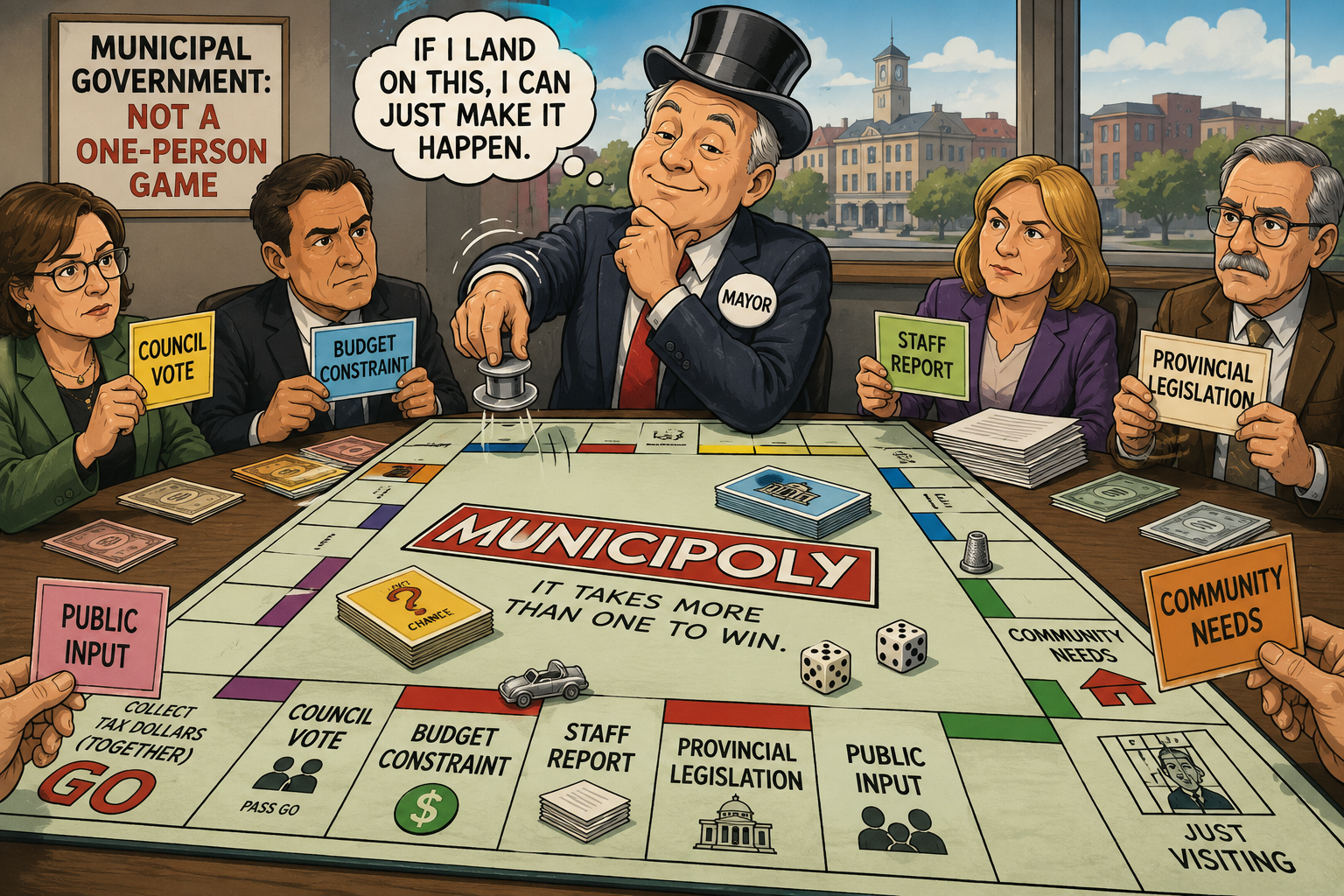
Image created by AI.
Editor: Laurel Davies Snyder
If you asked most people who is ‘in charge’ or runs a municipality, I suspect many people would give the same answer: “the Mayor”.
This answer makes sense. The Mayor is the person most people recognize. The Mayor facilitates and chairs Council meetings, speaks at grand openings and ribbon cuttings, attends announcements, sits in the front row at community events, speaks to the media when something goes wrong, and often becomes the face people associate with local government and their community.
During an election, the mayoral race tends to receive the most attention. People talk about who will “lead the municipality,” who will “set the direction,” and who will “get things done.” But this assumption is one of the biggest misunderstandings about local government and why a lot of other incorrect assumptions are made about who’s ‘in charge’. Spoiler alert – it’s not the Mayor.
The Mayor is not the boss of the municipality in the way many people assume. The Mayor is an important leader and often the most visible leader on Council, but municipal government is not a private company where the Mayor acts as the owner, president, or chief executive who can simply direct everyone who reports to them. In Ontario, the Mayor is the head of Council. Yes, they have statutory responsibilities, political influence, ceremonial duties, and, in some municipalities, new strong mayor powers. But even with these responsibilities, the Mayor does not govern alone.
The Mayor may be the face of the municipality, but that does not mean they handle everything on their own…and they shouldn’t.
This distinction especially matters during an election. We often evaluate mayoral candidates as though we are choosing the one person who will run the municipality by themselves. We ask what they will fix, what they will stop, what they will build, what they will cut, and how quickly they will make it happen. These are fair questions, but they are incomplete questions if we do not also understand the limits of the Mayor’s role and the role of all of Council. A Mayor may bring vision, energy, and leadership to the table, but they still operate within a legislative framework and provincial priorities, within municipal budgets, and within staff structures and required Council procedures, and most importantly, as one member as part of Council.
Assuming that the Mayor is ‘the boss’ and has the ability and leeway to manage everything on their own is a dangerous misunderstanding which can have consequences. If voters expect the Mayor to personally fix every road, stop every development, lower every tax bill, settle every dispute, and direct every department, disappointment is almost guaranteed. Not because the Mayor does not matter and not because their voice is not important, but because the role of Mayor was never designed to work that way.
Leadership Is Not the Same as Control
One of the biggest misconceptions about the Mayor’s role is the idea that leadership also means control. We often expect a Mayor to ‘take charge’, especially when people are frustrated. If a road is not being fixed quickly enough, if taxes are rising, if a development proposal is controversial, or if Council seems divided, people naturally look to the Mayor and ask why they are not simply solving the problem.
But a good Mayor is not effective because it’s assumed that they can control everything. A good Mayor is effective because they understand how to lead within a system where they do not have absolute control.
Leading within a system means building relationships with other members of Council. It means helping to set priorities that aren’t instructions or orders in disguise. It means working with the Chief Administrative Officer (CAO) and senior staff in a way that respects the professional administration. It means knowing when to speak, when to listen, when to build consensus, and when to let Council work through a disagreement without trying to dominate and control the decision.
The best Mayors I have worked with are not always the loudest or the most forceful. They are often the ones who can read the nuances in a discussion around the table, understand pressure points of an issue, and help move a difficult conversation toward a decision. They do not need to ‘own’ every good idea. They do not treat disagreement as disloyalty. They do not confuse being challenged with being undermined. They understand that if Council as a Whole functions well, the municipality also functions well, and everyone benefits.
This kind of leadership is not always dramatic and may not fit neatly into campaign slogans. But this type of leadership matters.
MYTH VS. REALITY
What people often think: The Mayor can direct staff, stop projects, overrule Council, and make things happen.
What the role actually involves: The Mayor leads, facilitates Council meetings, represents, influences, and helps set direction. But the Mayor is still required to work within the Council process and legislative framework, within approved municipal budgets, and within an organizational staff structure, provincial rules, and legislated required public processes.
Council as a Whole Still Matters
Don’t make the mistake of thinking that the mayoral race is the only race that matters.
Even when a municipality has a strong and respected Mayor, Council as a Whole and Councillors as individuals still matter. Councillors are not background characters in a mayoral story. They are elected representatives with their own responsibilities, their own opinions and evaluations, and every Councillor is obligated to participate in making decisions for the community.
A Mayor may help set the tone, but Council as a Whole makes the decisions – as a group. Council debates the budget. Council considers planning applications. Council passes By-laws. Council sets policy. Council receives staff reports, asks questions, and weighs competing interests. And ultimately, Council votes on items. If Council is dysfunctional, unprepared, unwilling to listen, or more interested in performance than in decision-making, even a capable Mayor will struggle to move the municipality forward.
The reverse is also true. Even when Councillors disagree, a functional Council can move forward and do good work, provided there is trust, respect, and discipline around the table to keep moving forward. The Mayor is part of this, but not the only part.
This is why municipal elections should never be treated as though one position or person can carry the entire term. You are not simply choosing a Mayor. You are choosing an entire Council, and the combined strength of that Council and how they can work together will shape what happens over the next four years.
So, What Changed With Strong Mayor Powers?
This discussion has become more complicated in Ontario because of Strong Mayor Powers. In 2022, the province granted the heads of council in some municipalities with the option of using additional tools to bypass traditional majority council votes in areas. These areas are largely tied to advancing provincial priorities such as housing, transit, and infrastructure. This is called ‘Strong Mayor Powers’ and voters should understand what it means.
In strong mayor municipalities, the Mayor may have powers that did not historically sit with the head of Council in the same way. Depending on the municipality and the applicable rules, those powers can include proposing the municipal budget, vetoing certain By-laws that could interfere with provincial priorities, appointing the Chief Administrative Officer, hiring and firing senior staff, creating or reorganizing certain committees, and bringing forward certain matters connected to provincial priorities.
These are significant powers and they can change the relationship between the Mayor, Council, and administration in ways that deserve attention. These powers also change what voters should ask mayoral candidates, because the role of mayor is no longer the same in every Ontario municipality.
But strong mayor powers still do not mean the Mayor is suddenly the boss of everything. And this is the part that can get lost.
Strong mayor powers give the Mayor more tools. They do not turn the municipality into a one-person government.
Strong mayor powers create additional authority in specific areas and under specific rules. There are often requirements for documentation, timelines, override provisions, and legislative limits. Strong mayor powers do not eliminate the role of Council. They do not remove the need for good judgment. They do not make staff the personal employees of the Mayor. They do not make provincial legislation irrelevant or disappear. They do not turn an integrated and complex municipal system into a one-person operation.
In some ways, strong mayor powers may make the question of leadership more important. When one office has the potential to hold more authority, the character, conduct, and behaviour of the person holding that office is even more significant. Their behaviour may also be more scrutinized; people may ask even more questions about decision making, transparency, due process, and other items.
Strong Powers Require Strong Judgment
There is a temptation to hear the term “strong mayor” and assume that strength means using every power available as often as possible to achieve a goal This is not necessarily true.
Sometimes the strongest use of power is restraint.
A Mayor granted with strong mayor powers must still ask whether using those powers will improve the decision or simply escalate conflict. They must consider whether they are advancing a legitimate municipal or provincial priority or using strong mayor powers to bypass a difficult conversation or potentially beneficial consultation. They must weigh using strong mayor powers against whether a decision will hold up over time, whether Council and staff can implement the decision effectively, and whether the public can understand why a certain decision was made.
There may be situations that lend themselves to using strong mayor powers, and it is entirely appropriate and benefits the community. There also may be situations where failing to use them would be a missed opportunity. And there may also be situations where using strong mayor powers too quickly, too often, or without a clear explanation for why they are being used can damage trust in the process and those elected to public office.
This is why voters should be cautious about candidates who speak about strong mayor powers as though these powers are a shortcut around Council, staff, or public process. Shortcuts are rarely free. The costs of shortcuts are often seen later whether it’s in broken trust, damaged relationships, rocky implementation, or loss of public confidence.
A strong Mayor is not simply someone willing to use power. A strong Mayor is someone who understands when power should be used, when it should not be used, and how to explain that choice to the people they serve.
The Mayor Alone Cannot Fix a Broken Council
Trying to ‘fix’ a broken Council is where the role of mayor can become difficult.
A Mayor is expected to lead, but they cannot make everyone around the Council table be thoughtful, prepared, respectful, or collaborative. They can influence the tone of discussions, but they cannot single-handedly tell people how to conduct themselves or automatically instill wisdom or experience if it does not already exist. They can encourage and facilitate organized and balanced debates, but they cannot force members of Council to listen to each other. They can try to build consensus, but they cannot guarantee it.
This is why who to elect as Mayor is not the only item to think about in the upcoming election.
If voters want a Council that can move things forward, they need to pay attention to who sits in every seat around the Council table. A skilled Mayor surrounded by Councillors who are only interested in fighting to defend their personal viewpoints will spend a great deal of time managing conflict. A thoughtful Mayor surrounded by members who refuse to read reports, understand budgets, respect staff, or consider the broader community will be limited by the quality of effort put in by those at the table.
A municipality is not well served when voters put all their hope in one person and ignore the rest of the Councillors they are electing. Doing that is how communities end up disappointed. They elect a Mayor with a vision, then discover that vision must still survive debate, budget limitations, capacity of staff, competing priorities, provincial rules, and the votes of other elected officials.
That does not mean vision is unimportant. It means that vision alone is not enough.
What Voters Should Listen For
When you are listening to mayoral candidates, listen for more than confidence. Confidence is useful, but it is not the whole job. Listen for whether they understand the difference between leadership and control. Listen for whether they respect the role of Council, even while asking to lead it. Listen for whether they understand the role of staff, the limits of municipal authority, and the importance of making decisions that can be explained and defended.
A useful question to ask a mayoral candidate is: “How would you lead a Council that does not always agree with you?” Another is: “When would you use strong mayor powers, and when would you choose not to?”
That second question reveals a candidate’s understanding and beliefs about power. Do they see it as a tool to be used carefully, transparently, and in the public interest? Or do they see it as a way of getting around people who disagree with them and do what they want?
Voters should also listen for how mayoral candidates speak about staff and Councillors. A mayoral candidate who treats everyone as an “obstacle” may struggle once elected, because those same people will still be part of the system they need to lead. A mayoral candidate who can disagree without contempt, challenge without belittling, and lead without pretending they alone have all the answers shows a better understanding of the role.
So, what can you do as a voter?
You can ask questions, and here are some questions you can ask Mayoral Candidates.
How would you lead a Council that does not always agree with you?
When would you use strong mayor powers, and when would you choose not to?
How do you see the relationship between the Mayor, Council, the CAO, and staff?
What does good leadership look like when you do not have full “control”?
And remember, the Mayor can set the tone
The Mayor may not be the boss, but that does not mean the role is small.
The Mayor sets a tone that can shape the entire term. They can model what good preparation looks like or rely on a performance. They can encourage respectful debate or reward division. They can help the public understand difficult decisions, or they can make decisions harder to trust by hiding behind process. They can build relationships with other governments, community organizations, businesses, First Nations, agencies, boards, and neighbouring municipalities. They can help Council stay focused on long-term priorities when the pressure of the week is pulling everyone in different directions.
This is real leadership. It’s leadership through balanced evaluation and decision-making, informed judgment, clear and consistent communication, transparency, preparation and research, and taking time to build trust. This is not ‘leadership through command and control’.
A Mayor who understands this can be incredibly effective. A Mayor who does not can make the municipality harder to govern and move forward on positive change, even if mayors today can technically hold more power than mayors in the past.
What This Means for the October 2026 Municipal Election
When you vote for Mayor, you are not choosing the person who will personally run every department, fix every road, stop every project, approve every budget line, and settle every disagreement.
You are choosing the person who will chair Council as a Whole, represent the municipality, help set direction, influence priorities, communicate with the public, work with staff, build relationships, and, in strong mayor municipalities, exercise additional authority with care and consideration.
That is a big job.
But it is not the job many people imagine when they say, “the Mayor should just fix this.”
So, this election year, it may be worth asking a different set of questions. Not only: “What does this candidate want to do?” but also: “Do they understand what the Mayor can do within their defined role on Council? Do they respect the role of Council? Do they understand the limits and responsibilities of strong mayor powers? Can they lead people who disagree with them? Can they use authority without becoming careless with it?
The best Mayor is not the person who promises to be the boss.
The best Mayor is the person who understands that they are not the boss and knows how to lead anyway.