Council Decisions Are More than Headlines, Soundbites and Social Media Posts
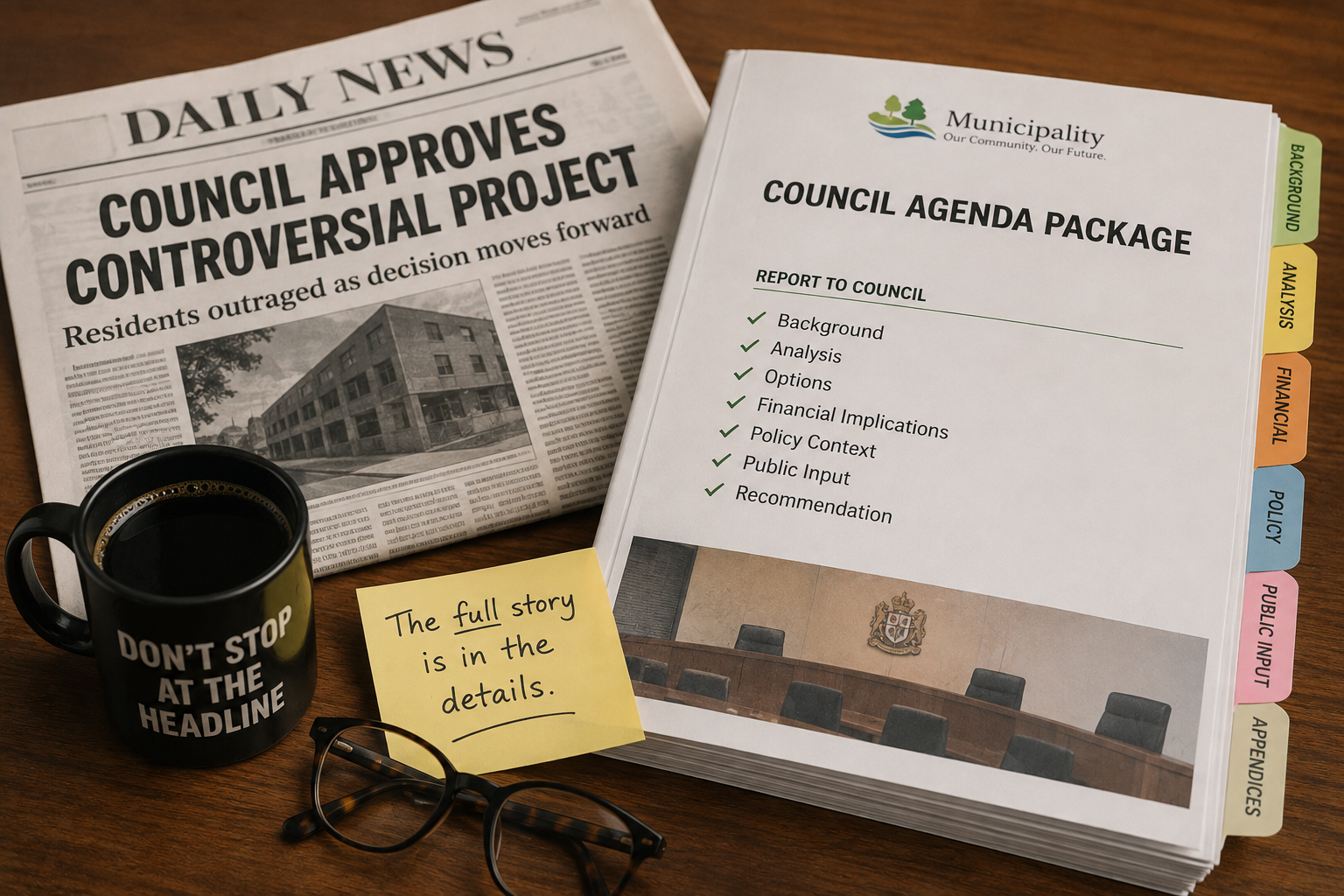
Image created by AI
Editor: Laurel Davies Snyder
Most people do not wake up on a Friday morning feeling excited to read a 347-page Council Agenda. Fair enough, and understandable.
People are working, raising children, running businesses, caring for parents, driving kids to hockey practice, making meals, checking emails and returning calls, taking courses, and trying to get through the week. People know that local government matters, but for most, reading Council Agendas and keeping up with local government cannot be their full-time job. This means that people’s first introduction to a Council decision is not through reading a Council Agenda a Staff Report. It is not by attending a Public Meeting, listening to a full discussion and debate, or watching the process of a recorded vote.
For many, their first introduction to a Council decision is the headline in the local newspaper. Or a post on Facebook. Or comments in an online forum. Or someone in the grocery store saying, “Did you hear what Council just did?”
By the time people seek more information, the issue’s many details and the application’s complexity may have been reduced to an oversimplified version. Council’s decision has already become a headline or soundbite stripped of context: Council approved the project. Council denied the application. Council raised taxes. Council ignored residents. Council wasted money. Council sold the land. Council delayed the decision. Council gave someone a break. Council refused to help.
This is one of the reasons why municipal processes and municipal decisions are easy to misunderstand. Although these statements may technically be true and may accurately report a Council decision, they are missing what matters in fully understanding the entire situation – the background information and decision-making context.
A headline can tell you the end result, but it rarely tells you the full story of why it happened, what options were also viable and debated, what Council was legally able to do, what staff recommended, what financial consequences were considered, or what would have happened if Council had made a different decision.
This is not a criticism of local journalism. Good local reporting is one of the reasons we are often aware of municipal issues and decisions. Reporters translate long meetings, complex processes, dense reports, and technical issues into something people want to read, and can easily understand while they’re managing everything else. But no headline, article, social media post, or conversation can replace reading the full Council Agenda package and being engaged in the process if we want to understand the full scope of an item, and details involved in making a specific decision. Before we pass judgement on what we think of a Council decision, it helps to understand the details involved in what Council is being asked to decide and what they are able to decide.
The Vote is Only the Tip of the Iceberg
One of the easiest mistakes to make when watching local government from the public perspective is assuming that the vote on an issue by Council is the entire issue. It’s not; the vote is a highly visible part of a process but it’s just the tip of the iceberg.
Depending on the complexity of the project or proposal, the work on the file has been going on for months and possibly years. This is normal and expected. Before the Council vote, the process has likely included many consultation meetings with municipal staff and various agencies & organizations, staff review of draft proposals and applications, review by municipal engineering staff, Public Notices, Open Houses, budget discussions, consultation with legal professionals, circulation to organizations an agencies who have interest or legislated role in the process, environmental considerations, review of background reports (like an Environmental Impact Study (EIS), Transportation Impact Study (TIS) or Agricultural Impact Assessment (AIA)), infrastructure analysis, and several rounds of revisions. This and more are part of the background and administrative work required to get a proposal ready for a Council Agenda. Although this is where the majority of the work occurs, it is not what the public sees.
By the time something reaches Council, many of the required steps in regulated and legislated processes have been completed. This does not mean that an outcome is predetermined, and it certainly does not mean Council should simply ‘rubber-stamp’ whatever is in front of them. It means that every proposal and item requiring a Council discussion and decision goes through a transparent and consistent process. This also means that a Council decision is not as spontaneous as it may appear to the public.
However, what people post online typically reduces these details and complexity into a soundbite or two-sentence summary. And unfortunately, as outrage tends to move faster than context, the two-sentence summary or four-word headline can become a catalyst for overall community misunderstanding and frustration.
A resident may assume that despite neighbourhood opposition, Council ignored the public because they read that Council approved a development. However, the staff report may show that the proposal:
meets overall community goals (like providing needed infrastructure for active transportation or more housing);
conforms and aligns with policies and evaluation criteria set out in legislation (Provincial Planning Statement, Community Official Plan);
meets all requirements set out in the Zoning By-law;
can be adequately serviced by existing water and sewer services; and,
all the technical items can be addressed.
If Council refuses or denies a Planning application that does all of the above - conforms to legislation, meets the requirements of the Zoning By-law, can be adequately serviced, and it has been shown that any technical items can be addressed - voting to refuse this type of proposal would be very difficult to defend on the basis of Planning legislation at the Ontario Land Tribunal (OLT).
Another person may read that Council ‘delayed’ a project and assume that Council is dragging its collective feet. But the Staff report may explain that in fact, deferring the decision was the recommendation presented to Council for decision. Funding may not be secure, the design may be incomplete, the municipality may be waiting on provincial approval, or the project may create a larger financial problem if rushed. Recommending deferral is often a reasonable approach and best for the community as a whole.
Someone else may read that Council increased taxes and assume that Council lacked discipline or made a mistake with budgeting. But the data may show that the Municipal Budget did account for rising insurance costs, infrastructure deficits, policing costs, debt obligations, collective agreements, asset management requirements, and service pressures and there was far less room for Council to manoeuvre than people expected.
The vote matters. But the details of the file matter more.
The Agenda Is Where the Story Starts
Most people are not going to sit down with a coffee and read hundreds of pages of municipal reports on a weekend. Even people who work in municipal government sometimes look at a Council Agenda package and take a deep breath before opening it.
However, if you want to better understand what is happening at Council, the Council Agenda is usually the best place to start. You don’t need to read everything to become better informed. You just need to know where to look and how to start.
Start with the Recommendation. This tells you what Council is being asked to consider and vote on. Sometimes the public conversation around an issue is much broader than the specific decision in front of Council. Residents may think that Council is deciding whether they like a project, agree with a business, support a neighbourhood, or approve of a person. However, when you look at the recommendation in front of Council, they are probably being asked to consider and decide on a very specific item, such as whether an application meets the policy framework, whether a procurement process was followed, whether funding should be allocated, or whether staff should be directed to bring more information to a future Council meeting.
Next, read the Background and Analysis sections. These sections explain how and why the recommendation was developed by staff. These sections will summarize previous Council direction, relevant legislation, policies and by-laws, technical findings, financial considerations, public comments, alternatives, and risks.
Look for the financial implications. Sometimes there are costs associated with a decision, and staff reports typically include this information. If the staff report does not identify an immediate cost and future costs to the municipality, Council can request this information to better inform their discussion and decision at a future meeting. It’s important to recognize that sometimes the most expensive decision is not the one that costs money today, but the one that creates vague and unknown financial obligations for future municipal budgets, whether it’s new staff, new equipment, future servicing (water and sewer), or expanded infrastructure like a new road.
Understand Council’s Scope – what kind of discretion or flexibility do they have with a decision? We may assume that Council has a great deal of flexibility with every decision. But understanding the actual scope of what Council is able to decide is important. There are times when Council has flexibility, however, more often than not, legislation, policy, contracts, funding rules, processes, and previous decisions provide a definite scope for a decision. So, if Council has three choices for a decision, judging their final decision as though they had thirty choices is not accurate, and can result in frustration.
Finally, look for what will happen next. Many Council decisions are a step in the process. Sometimes Council is voting to receive information, direct staff to investigate further and provide more information, start a public process, approve a study, or move something to the next stage. A decision that sounds dramatic in a headline may be one step in a process. Understanding this difference can change how you react.
Online Comments Are Not Council Reports
In many ways, communicating using social media has made municipal government more visible and transparent than ever. It’s another method to inform the community, it allows people to quickly share their ideas and concerns, and like-minded people can easily connect to discuss issues, ask questions, organize ideas, and bring attention to things that may otherwise be missed.
Sometimes online comments are accurate and identify key issues. Sometimes they pose great questions and raise concerns that deserve a thorough response and investigation by the municipality. But sometimes online comments aren’t related to the facts or the information in the staff report presented to Council. Sometimes online comments contain inaccurate assumptions based on incomplete information, which can lead to opinions and explanations about what ‘should’ happen. When inaccurate information and assumptions about a project or Council decision start to circulate online, it can quickly become the version people believe and becomes ‘the truth’. A decision about a complex planning proposal becomes “Council ignored the neighbourhood.” A decision about the budget becomes “Council wasted our money.” A decision about Staff becomes “Council is hiding something.” A deferred report becomes “Council refuses to act.”
Once the online version takes hold, it’s a battle to get the facts into the conversation. And facts rarely win. This isn’t because people don’t want to hear the truth or can’t handle complexity; it’s because most people have full lives and headlines and soundbites combined with short and simple explanations travel faster than pages and pages of information and facts.
This is exactly why civic literacy matters.
If we want more informed and involved local conversations, we need more people who are willing to pause before reacting and ask:“What was Council actually deciding, and what information did they have in front of them?”
Public Engagement Should Start Before Everyone Has Made Up Their Mind and is Angry at a Decision That Hasn’t Happened
One of the patterns with engagement in local government is that people tend to become engaged once they have read the online soundbite or short headline and are upset because of what they think is happening.
Again, this is understandable. People pay more attention when they think that something will directly and immediately affect their street, their taxes, their neighbourhood, their business, their commute, or their view from the backyard. Very few residents have time to monitor every Council Agenda just in case there is an item that may affect them, or in case there’s an item about an overall municipal service that matters to the community as a whole. But engaging late in the process has consequences. By the time an issue or proposal has reached the Public Meeting part of the process, a great deal has already happened. Background reports and required studies may be complete. Deadlines may be approaching. Funding windows may be closing. Legal issues were considered and analyzed.
This does not mean public input cannot be part of the process. It matters and is an important part of shaping how a community changes. Public input can help to identify issues, improve a decision by suggesting specific conditions, change a design based on experiences and knowledge of the item, influence timing, and help Council understand the specific impacts to the community. But it is much harder for public input to shape a decision when the first time that people engage is after they are already angry.
Solid Engagement Starts Early in the Process
But how do you know about an issue or proposal before the Public Meeting where Council will decide?
Proactive engagement starts with knowing where to find information about what’s going on in your municipality. Find out how to access the Council Agendas. Sign up for municipal notices and newsletters. Read Staff reports before making assumptions. If you have questions, contact staff or Council Members with specific questions rather than broad accusations. Ask whether the municipality is asking for input, making a final decision, or simply moving something to the next step.
Admittedly, most municipalities can improve their communication about projects including where to find information, sharing the steps in the process, how and when decisions will be made, and how and when the public fits into the process. Many reports are technical. Public Notices can be hard to understand, and receiving a notice from ‘the government’ does not always inspire enthusiasm. Many Council Agendas are written using specific language that is not always as user-friendly as it might be. Local government has work to do if it wants to encourage meaningful public participation.
But the public also has a role and responsibility. Democracy works better when people are informed.
As a Start, Take A ‘Five-Minute Agenda Test’
If you do not have time to read the whole Council Agenda, try this before forming a strong opinion about a Council decision.
First, find the staff report. Municipal websites post all reports online.
Second, read the recommendation and ask: “What is Council actually being asked to do? Approve, deny, receive, or direct?”
Third, skim the Background and Analysis sections in the report. Look for the reasons that support the specific recommendation presented by staff.
Fourth, check the Financial Implications of approving the recommendation. Is there a cost? Is there a funding source? Is there a risk of future costs?
Fifth, look for the legal, policy, or process constraints. Is Council free to decide whatever they want based on preference, or are they working within a specific policy, legal, or financial framework?
Sixth, if the meeting was recorded, watch the portion where Council asks questions. This is often more useful than watching the final vote. The questions can tell you whether Members of Council understood the issue, challenged the recommendation, considered alternatives, or simply moved through the item without much discussion.
This Five-Minute Agenda Test will not make every decision clear. But this process may give you a better understanding than what’s included in a headline, a rumour, or a comment thread on social media.
Why This Matters in an Election Year
In an election year, this matters even more because every Council decision becomes part of the political story. Candidates will point to past votes as evidence of failures or successes. Members of the public will bring up controversial decisions when candidates are at their door. Social media will revive old arguments. People will say that Council ignored them, wasted money, moved too slowly, acted too quickly, or made the wrong call. Some of those criticisms will be fair, and some won’t be accurate at all. The challenge for voters is knowing the difference.
Before accepting a candidate’s version of a Council decision, ask yourself if they understand the file or appear to be using the public frustration to support their own ideas. Did they read the report? Can they explain Council’s options for a specific vote? Do they understand the financial or legislative constraints? Can they tell you what they would have done differently and how that alternative would have worked? A candidate who criticizes a decision may be right. A candidate who cannot explain the decision has not yet earned the right to criticize. This is an important distinction.
The same applies to incumbent Members of Council. If a sitting Member of Council voted for something unpopular, voters have every right to ask why. But the answer should be more than “I thought it was best.” A responsible elected official should be able to explain what information they relied on, what alternatives they considered, what risks they weighed, and why they voted the way they did. The explanation may not make people agree with the decision, but it gives voters something better to evaluate than anger.
The Headline is Only the Beginning of the Story
Local government is close enough to our everyday lives that we can see it. But without a bit of work on our part, it’s also complex enough that what we see is often an incomplete picture that we can’t always relate to our own lives.
This is a difficult combination. It means that we can watch democracy happen in real time but can still miss most of the background and the process informing the decision. It may mean that we think that Council’s vote is obvious, but if we don’t see the limitations and scope of what they can do, we are frustrated. It means that a headline can be accurate and still not tell you enough to understand what really happened.
So, this election year, one of the most useful things voters can do is slow down the moment between hearing about a decision and deciding what they think of it.
Read the recommendation.
Skim the report.
Watch the questions.
Look for the constraints.
Understand the decision presented to Council.
Then, form your opinion. Because the headline may tell you where the story begins. But it should not be where your understanding ends.